
Edmonds Directory Collections by Year
Edmonds appears in several overlapping collections rather than one complete annual run. The Sno-Isle catalog identifies a dedicated Polk title, while the Washington State Library city-directory list places Edmonds inside Everett volumes. The county list adds broad Snohomish editions. Together, these shelves provide strong coverage, but the gaps must stay visible.
| Collection | Years | Where Held | Access |
|---|---|---|---|
| Polk's Edmonds | Catalog records include 1970, 1971, 1973 | Sno-Isle Edmonds and Stillygen | Catalog online; local volume in-library use |
| Edmonds in Everett directories | 1901-20, 1922-23, 1925-33, 1935, 1937, 1968-71, 1973-83, 1985 | Washington State Library | Cataloged; onsite or staff-assisted access |
| Snohomish County directories | 1882-87 through 2000-05, with gaps | Washington State Library and partners | Many onsite or microfilm-only |
| Sounder directory index | Includes a 1902-03 Edmonds item | Sno-Isle Genealogical Society | Journal index online; early volumes in libraries |
| Rural Heritage collection | Historic images and documents | Washington Rural Heritage | Free online; reuse rights vary |
The county runs are irregular: 1882-87, 1901-20, 1922-23, 1925-33, 1935, 1937, 1952-82, 1984, 1992-98, and 2000-05. A blank year does not prove a move or death. It may simply mean that no volume survives in the listed collection. Confirm the exact edition before planning a visit.
Finding the Polk Shelf
The most direct local catalog record is Polk's Edmonds (Snohomish County, Washington) City Directory. Sno-Isle assigns call number 917.9771 POLKS E and marks it for in-library use. Stillygen's catalog rows separately identify Edmonds editions for 1970, 1971, and 1973. Those records prove that editions exist, but they do not establish a complete run or supply scanned resident pages.
Start with the catalog, save the title, year, and call number, then ask staff which volume is present and whether advance retrieval is needed. The Edmonds Library at 650 Main Street offers computers, copying, and scanning. Its branch page does not promise newspaper microfilm or a named genealogy database, so verify those tools before traveling.
The catalog view helps set expectations before an in-library search.
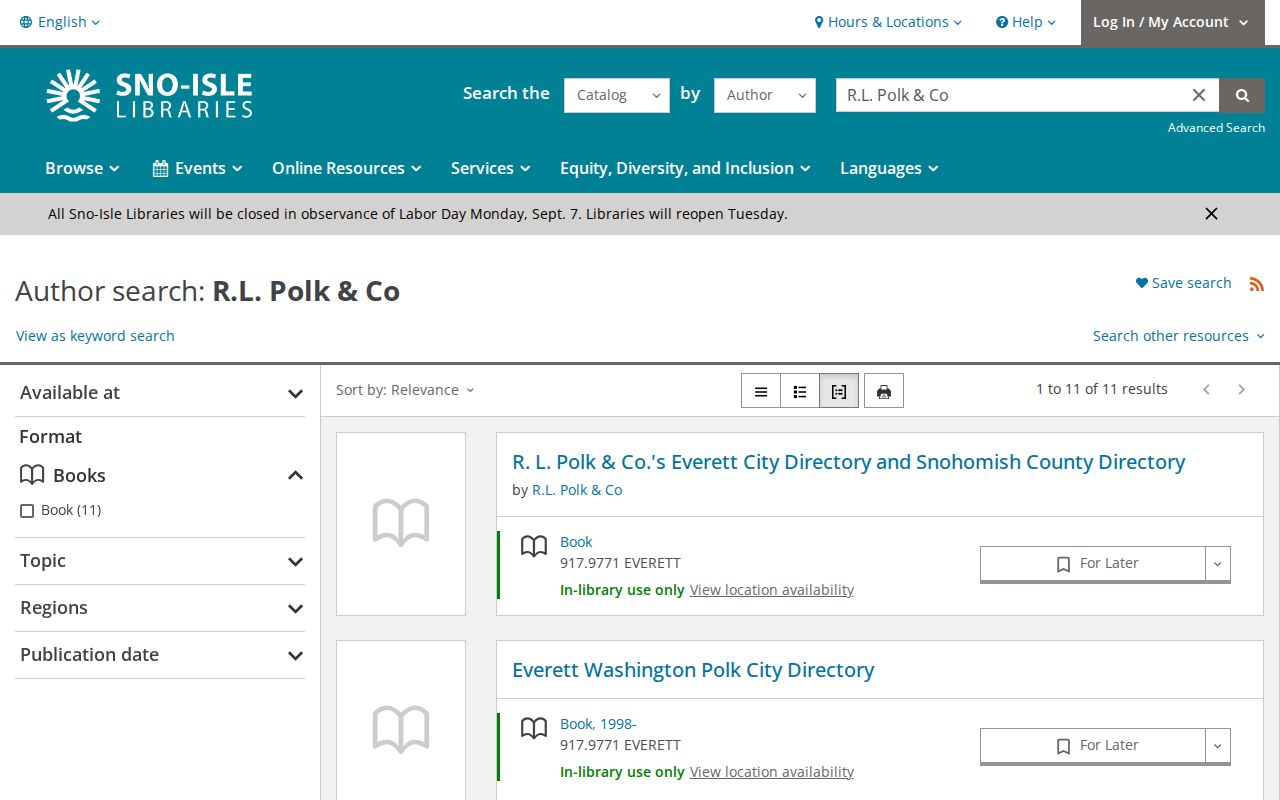
The captured catalog screen points to the official title record rather than an unverified scan of a private person's entry.
State Library Access Changes
The Washington State Library holds the broadest stated year coverage, but access changed in 2025. Its Tumwater building closed to ordinary public access on July 1 because of funding loss. Limited Thursday appointments from 1 to 4 remain. Call or email first, identify the exact Edmonds, Everett, or Snohomish County volume, and ask whether staff can confirm the item before an appointment.
This access limit makes Sno-Isle and regional partners important. A researcher can check a local catalog, ask about interlibrary help, consult the Sounder quarterly index, and then contact the State Library for the editions not held nearby. The 1902-03 Sounder reference is especially useful because it identifies Edmonds within Polk's Everett and Snohomish County directory.
Note: A public catalog listing does not mean a full directory scan is open online or that every listed year contains Edmonds names.
Reading Edmonds Directory Records
Begin with the facts actually printed on the page. Washington State Library guidance says directories commonly list adult names, occupations, and addresses. Some physical volumes may also use spouse references, street-order sections, or short codes, but those details must be checked against that edition's key. The inspected Edmonds catalogs did not expose an individual entry image, so no made-up sample should stand in for the page.
| Name | Copy spelling, initials, and order exactly as printed. |
|---|---|
| Occupation | Record the listed work and employer only when the entry states them. |
| Address | Keep the house number and street spelling from that edition. |
| Household notation | Note a spouse or cross-reference only when the volume defines it. |
| Source citation | Save publisher, title, year, page, and repository. |
- Criss-cross directory
- A section arranged by street and house number rather than by surname.
- Householder index
- A street or address list that points to the named adult associated with a household.
- Abbreviation key
- The edition's own list explaining short forms and symbols. Copy it before interpreting marks.
Children, people between homes, renters, and unlisted telephone users can be absent. Even an adult entry reflects publication data from one point in time. Compare it with a census, deed, or another edition before drawing a family conclusion.
Edmonds Museum Directory Surprises
The Edmonds Historical Museum's collection posts show why a city directory search should extend beyond the catalog shelf. Staff have surfaced a 1927 Seattle City Directory, Edmonds Independent Telephone Company material, real-estate and mortgage papers, and capital-stock records. A surname may appear through a business, telephone subscription, property paper, or photograph even when a dedicated Edmonds volume is missing.
The museum occupies the 1910 Carnegie Library at 118 5th Avenue North. The building served as a library from 1911 to 1962 and reopened as a museum in 1973. Its collections number in the tens of thousands, so a focused request works best: provide a surname, business, address, approximate year, and source already checked. Ask about collection context and copying rights.
An official collection post offers a glimpse of the museum's unusual discovery surface.
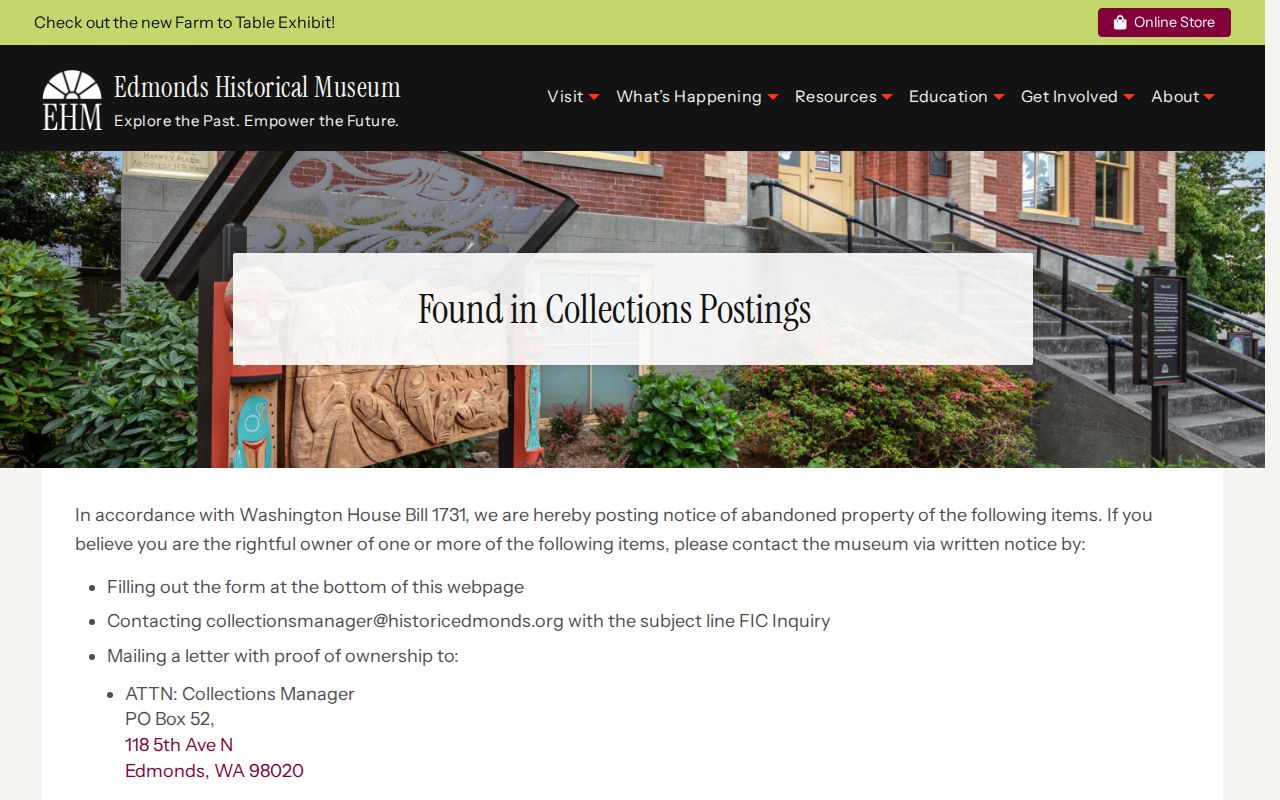
The page demonstrates that local directory evidence may sit beside telephone and property artifacts, not in a single resident database.
Edmonds Directory Years in Context
Local growth helps explain the changing records. George Brackett's settlement and logging activity began in the 1870s. Edmonds incorporated in 1890, the Great Northern Railroad arrived in 1891, and regular passenger ferry service began in 1900. Early city directory entries can therefore mix homes with mills, rail, ferry, and waterfront businesses.
| Period | Directory clue |
|---|---|
| 1882-87 | Early Snohomish County runs listed by the State Library. |
| 1901-37 | Edmonds appears in several Everett and county editions, with gaps. |
| 1952-85 | Postwar county and Edmonds-in-Everett volumes provide a longer household trail. |
| 1992-2005 | Later county runs are listed, again with missing years. |
The runs show scale, not certainty. Publication practices changed, and a county title might not cover every Edmonds street in the same way. Read the title page and geographic scope before using an entry.
Digitized Edmonds History Sources
Washington Rural Heritage's Sno-Isle collection is the best documented digital companion in the research. It includes Edmonds Historical Society photographs and documents involving businesses, churches, schools, the waterfront, ferry service, and residents. These images can explain an occupation or address found in a city directory, though they do not replace the printed volume.
The digital collection is searchable from home. Save the item title, holding institution, date, identifier, and rights statement. Copyright or reuse permission is not automatic merely because an image appears online.
The collection landing page shows the statewide access point for these local items.
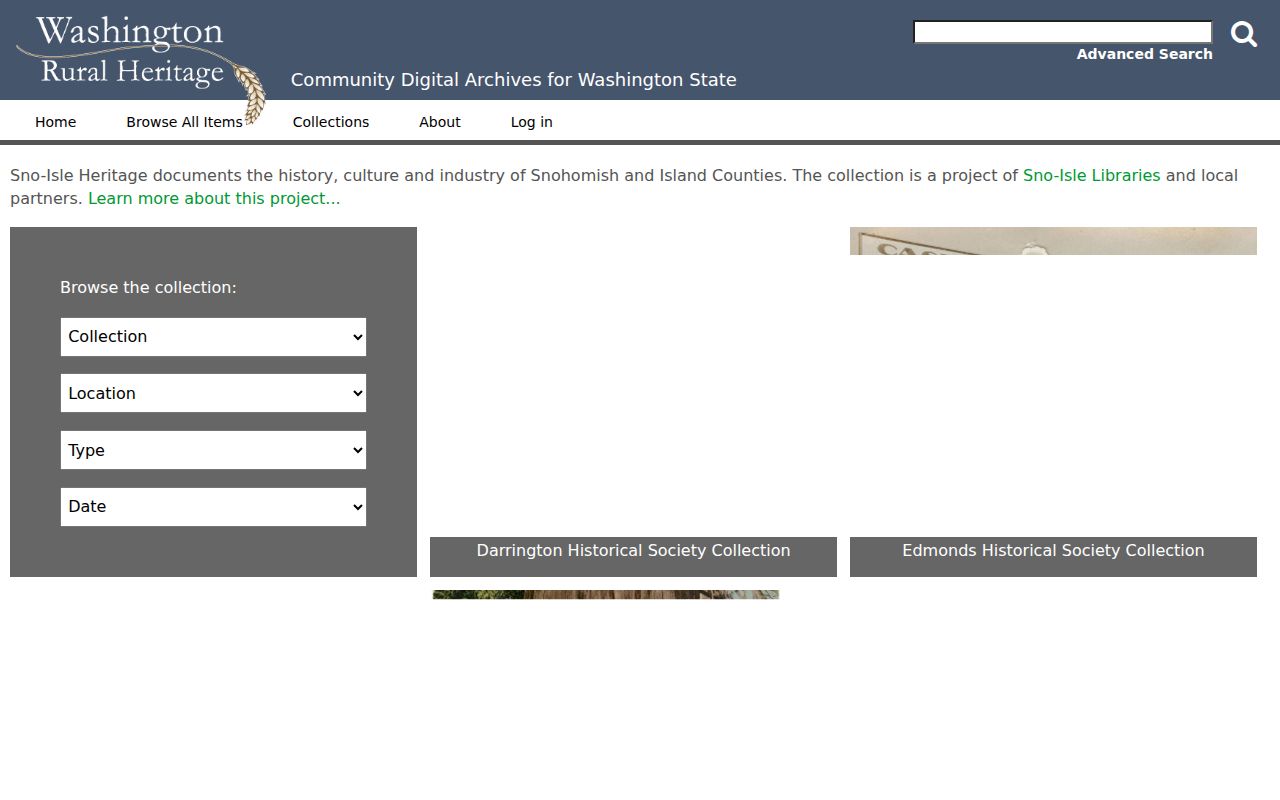
Pair an image's date and place with the exact directory citation to keep the historical link clear.
Trace Edmonds Directory Families
A careful family-history trail preserves what each source says and what it leaves open. Start with a known surname and approximate year. Work through every available Edmonds, Everett, or county edition, then use census and land records for independent checks. The city directory supplies snapshots between federal census years, while the census can add household structure.
- Find the surname in an available volume and copy the entry exactly.
- Check the next available year, recording address and occupation changes without treating a gap as absence.
- Use any street-order section to test the address and nearby names.
- Pair 1900, 1910, and 1920 directory evidence with the matching census and county deed chain.
- Check the Sounder index, Rural Heritage, museum, and cemetery for related evidence.
An address can change spelling or numbering, and a historic road may not map neatly to a present parcel. Preserve the original wording, then use plats, deeds, assessor history, and permit records to reconcile it. For modern address-keyed work, the Edmonds street directory keeps that separate from the historical shelf.
Disappearance has many causes. A person may have moved, died, changed a surname, joined another household, declined a listing, or fallen into a missing edition. Cemetery, probate, marriage, deed, and later directory evidence can distinguish those paths. One city directory hit is never enough on its own.